
Go straight to the source
Third-party data and AI summaries are incredibly useful for saving time, but serious investors eventually read the primary sources. The Filings tab provides direct access to the company's regulatory filings (like SEC documents for US companies).
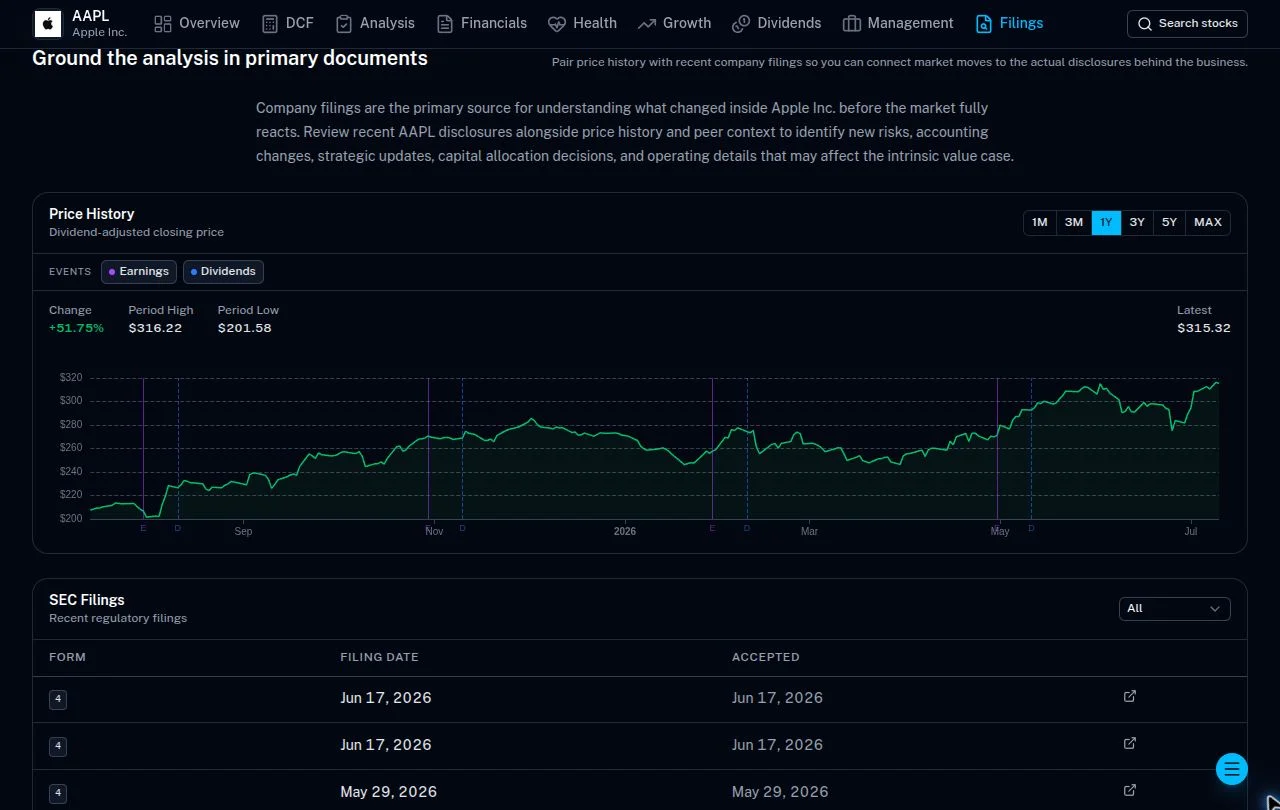
- 10-K (Annual Report): The most comprehensive document. It contains the audited financial statements, a detailed description of the business, and a crucial section called "Management's Discussion and Analysis" (MD&A).
- 10-Q (Quarterly Report): Unaudited quarterly updates. Useful for tracking short-term trends and seeing how the business is tracking against its annual goals.
- 8-K (Current Report): Filed when a major event occurs between quarters, such as an acquisition, a change in executives, or a bankruptcy filing.
Where to look first in a 10-K
Reading a 150-page 10-K cover-to-cover is exhausting. Know where to look to get the highest return on your reading time:
- Item 1: Business. How the company describes what it does. Compare this to your own understanding.
- Item 1A: Risk Factors. The lawyers make them list every possible thing that could go wrong. Many are boilerplate, but look for specific, unique risks (e.g., "70% of our revenue comes from Apple").
- Item 7: MD&A. Management's narrative explanation of the financial results. This is where they explain why revenue went up or down.
- The Footnotes: The small print after the financial statements. This is where accounting magic (like aggressive assumptions for pension liabilities or obscure off-balance-sheet entities) is hidden.
Read what they don't want you to read
Companies naturally want to highlight their successes. Always read the risk factors and the footnotes. If management spends three pages explaining a complex new non-GAAP metric that makes their earnings look better, they are probably trying to distract you from deteriorating core cash flows.