
Survive first, thrive second
A company cannot compound capital if it goes bankrupt. The Health tab is designed to help you quickly assess whether a company has the financial strength to weather an economic downturn or an industry specific shock.
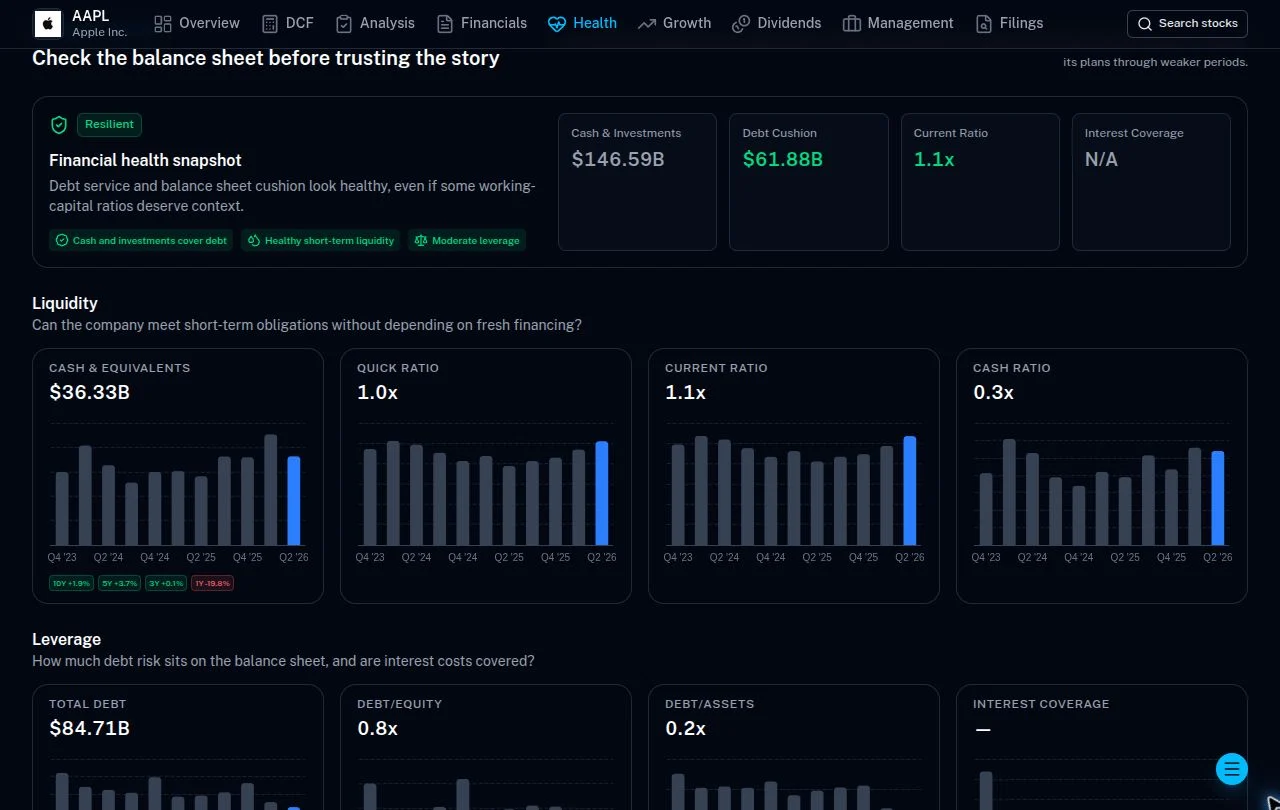
- Solvency: Can the company meet its long-term obligations? We look at total debt levels relative to equity and earnings power.
- Liquidity: Can the company pay its bills over the next 12 months? We analyze cash on hand and short-term assets relative to short-term liabilities.
- Credit Health: For companies where it's applicable, we provide standardized credit scores like the Altman Z-Score to estimate bankruptcy risk.
Assessing the debt burden
Debt isn't inherently bad—many great companies use leverage to enhance returns. But too much debt makes a business fragile.
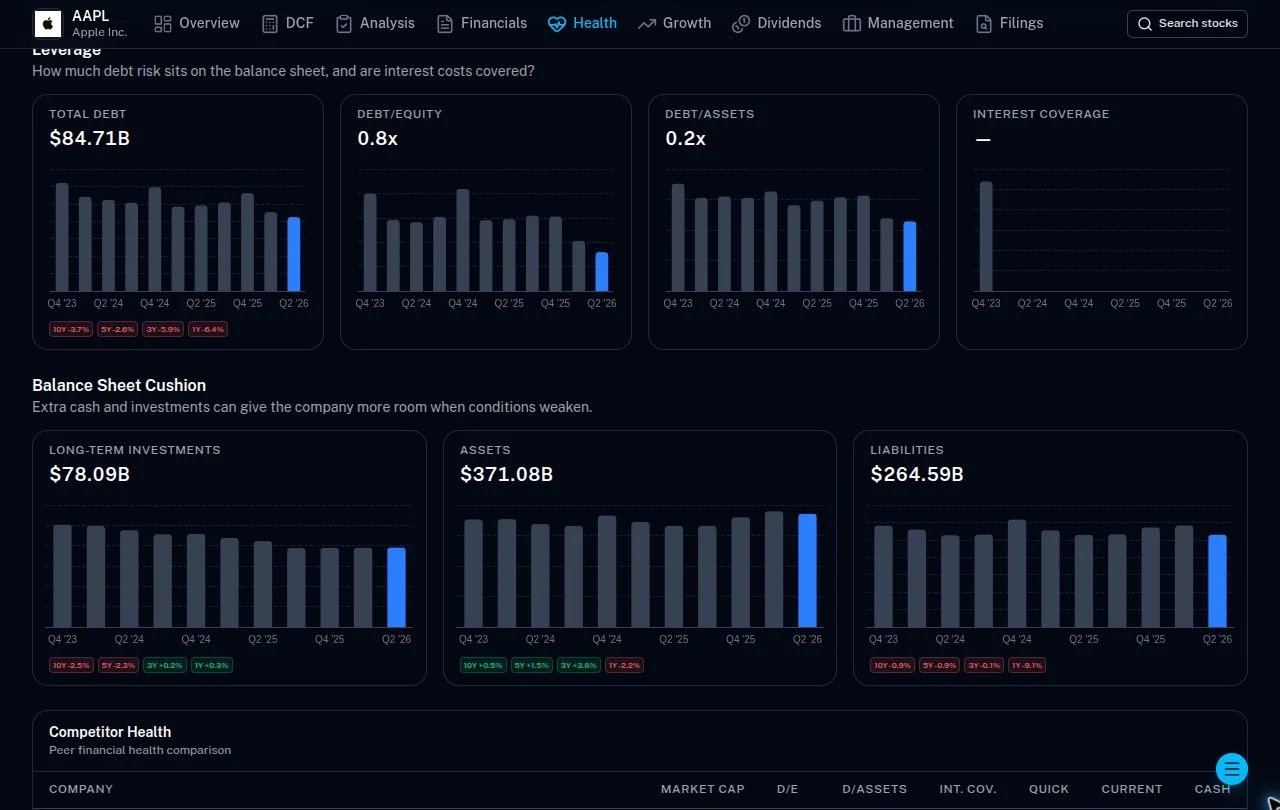
- Interest Coverage Ratio: This is arguably the most important debt metric. It tells you how many times a company's operating income (EBIT) can cover its interest payments. A ratio below 3x warrants caution; below 1.5x is a major red flag.
- Debt to Equity / Debt to Capital: These ratios show the capital structure. Highly cyclical businesses (like airlines or automakers) should carry less debt than stable, recurring-revenue businesses (like software or utilities).
Checking liquidity
Liquidity measures the company's short-term survival capability. If a sudden shock hits revenues, does the company have enough cash to keep the lights on?
- Current Ratio: Compares current assets to current liabilities. A ratio above 1.0 means the company can pay its immediate debts, but a very high ratio (e.g., >3.0) might indicate inefficient capital allocation.
- Quick Ratio: A stricter measure that excludes inventory, focusing only on cash and easily convertible assets. It's especially useful for retail and manufacturing businesses where inventory might be hard to sell quickly in a crisis.